
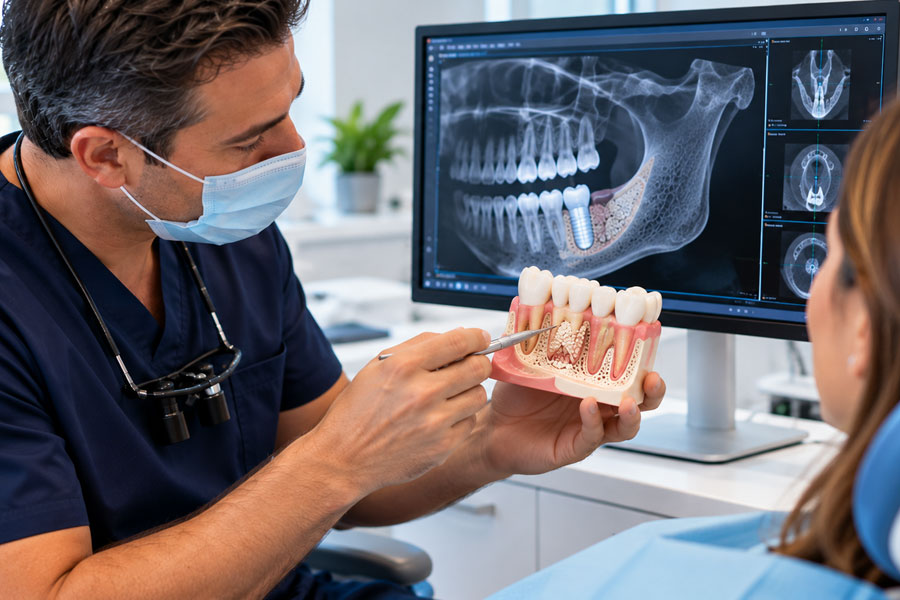
Bone loss in the jaw can occur following tooth loss, gum disease, infection or dental trauma. At Wise Dental, we provide dental bone grafting treatments designed to rebuild areas where bone volume has reduced and create a stronger foundation for future dental treatment.
Bone grafting is commonly recommended before dental implant treatment when there is not enough healthy bone to adequately support an implant. The procedure encourages new bone development and helps restore strength and volume to the affected area of the jaw.
Your dentist will assess the condition and density of your jawbone before recommending treatment. Bone grafting may be considered in several situations.
When a tooth has been missing for an extended period, the bone that previously supported it can gradually reduce in volume. A bone graft may help rebuild this area before an implant is placed.
Dental implants require sufficient bone for support. If scans show that the jawbone is too thin or lacks adequate density, grafting may be recommended as part of your implant treatment plan.
Advanced periodontal disease can damage the tissues and bone supporting the teeth. Depending on the extent of the damage, grafting may be considered to help restore lost bone.
Significant jawbone deterioration can contribute to changes in facial appearance. Restoring bone volume may help provide additional support to the surrounding oral structures.
Changes in the shape of the jaw over time can affect how dentures or other dental restorations fit. Your dentist can assess whether bone loss is contributing to these changes.
Different grafting materials can be used depending on the location of the bone loss, the amount of bone required and your individual treatment needs.
An autograft uses a small amount of your own bone, collected from another suitable area of the body. Because the material comes from the patient, it can integrate effectively with the existing bone.
An allograft uses carefully processed donor bone obtained through an approved tissue source. This approach avoids the need to collect bone from another area of your own body.
A xenograft uses specially processed bone material derived from an animal source, commonly bovine. The material acts as a framework that supports the development of new bone within the treatment area.
Synthetic grafting materials are manufactured from biocompatible substances designed for use within the body. They can provide an alternative when biological donor material is not required or preferred.
Treatment begins with a detailed examination of your teeth, gums and jaw. Dental X-rays or 3D imaging may be used to assess the amount and quality of available bone and determine the most appropriate treatment approach.
The treatment area is numbed using local anaesthetic. Depending on the procedure and individual circumstances, additional sedation options may also be discussed with your dentist.
The selected grafting material is carefully positioned in the area where additional bone volume is required. It is then stabilised to encourage healing and new bone formation.
In some cases, a specialised membrane may be positioned over the graft. This helps protect the area and provides an environment that supports bone regeneration.
Once the graft has been placed, the treatment area is closed with sutures. Over the following months, the graft gradually integrates with the surrounding jawbone.
Healing varies between patients and depends on factors including the size and location of the graft, the material used and your general oral health.
Bone grafting can provide several benefits as part of a broader restorative or implant treatment plan:
Your dentist will provide personalised instructions following your procedure. Some tenderness, swelling or minor discomfort around the treatment area can be expected during the initial healing period.
For a smoother recovery, you may be advised to:
Although the gum tissue generally heals considerably sooner, development and integration of the underlying bone can take several months. Your dentist will monitor your progress and advise when the area is ready for the next stage of treatment.
If bone loss is preventing you from proceeding with dental implants or affecting your oral health, the team at Wise Dental can assess your jaw and discuss the treatment options available.
Our Sutherland Shire dental team can develop an individual treatment plan based on your bone structure, oral health and longer-term restorative needs.
Book a consultation with Wise Dental to find out whether dental bone grafting is suitable for you.
Book a ConsultationAny surgical or invasive procedure carries risks. Your dentist will discuss the potential benefits, risks and alternative treatment options with you before proceeding.