
Regular snoring can affect the quality of your sleep as well as that of the people around you. In some cases, persistent loud snoring may also be associated with a sleep-related breathing disorder such as obstructive sleep apnoea.
Obstructive sleep apnoea occurs when the upper airway repeatedly becomes narrowed or blocked during sleep, interrupting normal breathing.
At Wise Dental, we can assess whether a custom-made oral appliance may be appropriate for patients who have been diagnosed with, or appropriately assessed for, certain sleep-related breathing problems.
Obstructive sleep apnoea, commonly referred to as OSA, is a condition in which breathing repeatedly reduces or stops for short periods during sleep.
When you fall asleep, muscles throughout the body relax. In people with obstructive sleep apnoea, tissues around the throat and airway can relax sufficiently to restrict airflow.
When the brain detects disrupted breathing, it can briefly wake the body enough to restore airflow. These interruptions may occur repeatedly throughout the night, sometimes without the person being aware that they’ve woken.
As a result, someone may appear to have slept throughout the night but still wake feeling tired or unrefreshed.
Because sleep apnoea occurs while you’re asleep, another person may notice the symptoms before you do. Possible signs can include:
Snoring alone doesn’t necessarily mean you have sleep apnoea. However, persistent loud snoring combined with breathing pauses, gasping or significant daytime tiredness should be properly investigated.
No. Snoring and sleep apnoea aren’t the same condition.
Snoring occurs when airflow causes tissues within the upper airway to vibrate during sleep. Many people who snore don’t have obstructive sleep apnoea.
With sleep apnoea, breathing itself becomes repeatedly restricted or interrupted.
Because the symptoms can overlap, it’s important not to assume that a dental appliance for ordinary snoring is automatically an appropriate treatment for suspected sleep apnoea.
If your symptoms suggest OSA, appropriate assessment and diagnosis should come before treatment.
Obstructive sleep apnoea can affect both sleep quality and general health.
Repeated breathing interruptions can prevent normal restorative sleep and contribute to significant daytime tiredness and reduced concentration.
Untreated OSA has also been associated with increased risks of several health problems, including cardiovascular conditions, high blood pressure and motor vehicle accidents related to excessive daytime sleepiness.
For this reason, suspected sleep apnoea shouldn’t simply be treated as a snoring problem.
If you’re experiencing symptoms, particularly witnessed breathing pauses, gasping during sleep or significant daytime sleepiness, speak with an appropriately qualified healthcare professional about assessment.
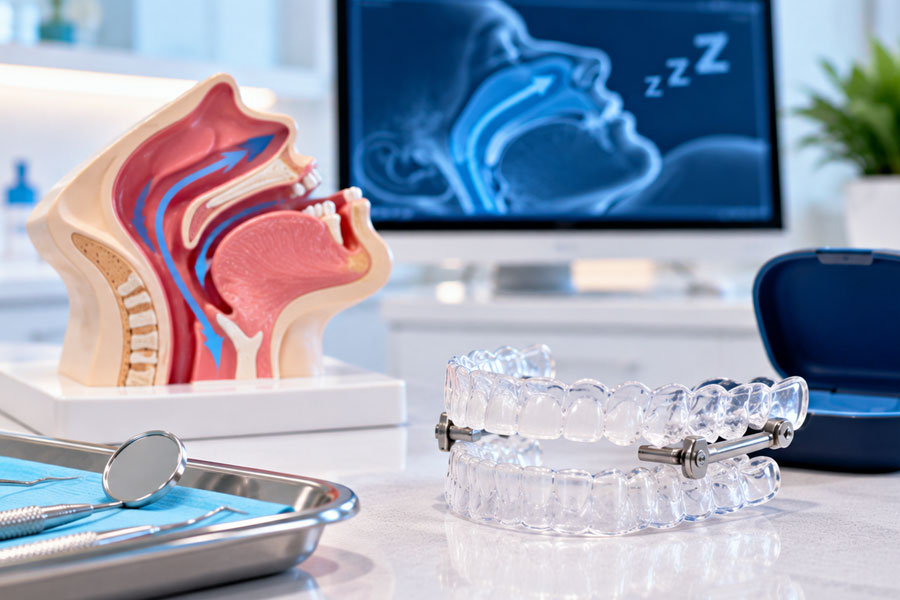
A Mandibular Advancement Splint (MAS) is a custom-made oral appliance worn inside the mouth while you sleep.
It may look somewhat similar to a dental mouthguard or retainer, but it serves a different purpose.
The appliance is designed to hold the lower jaw in a slightly forward position during sleep. This can also influence the position of the tongue and surrounding soft tissues, helping maintain space within the upper airway.
Mandibular advancement devices may be used for certain patients with snoring and some cases of obstructive sleep apnoea following appropriate assessment.
When the jaw and tongue move backwards during sleep, the space available for airflow through the upper airway can become narrower.
A mandibular advancement splint gently positions the lower jaw further forward. For suitable patients, this can help reduce airway narrowing during sleep and may reduce snoring and sleep-related breathing disturbances.
The amount of advancement required differs between individuals, which is why the appliance needs to be appropriately fitted and adjusted rather than relying on a generic mouthguard.
At Wise Dental, mandibular advancement splints are individually made to fit the patient’s teeth and mouth.
A custom appliance provides a more precise fit than an off-the-shelf device and allows the jaw position to be adjusted where appropriate. Potential advantages of a custom oral appliance include:
Whether an oral appliance is suitable depends on your diagnosis, dental health and individual circumstances.
A mandibular advancement device isn’t appropriate for everyone who snores or has sleep apnoea. Suitability can depend on factors including:
Your dental assessment allows us to determine whether your teeth and bite are suitable for an oral appliance.
Where sleep apnoea is suspected but hasn’t been diagnosed, further medical or sleep assessment may be required before treatment.
Your dentist will discuss your symptoms, dental health and any existing diagnosis or sleep assessment.
Your teeth, gums, bite and jaw will also be examined to determine whether an oral appliance may be appropriate.
Detailed records of your teeth and bite are taken so the appliance can be individually manufactured.
Your mandibular advancement splint is created specifically for your mouth rather than using a generic one-size-fits-all appliance.
Once your appliance is ready, your dentist checks its fit and how your upper and lower teeth come together.
The appliance may be progressively adjusted to achieve an appropriate jaw position while maintaining comfort.
Follow-up appointments allow the condition of your teeth, bite and appliance to be monitored.
Where the device is being used as part of sleep apnoea management, appropriate follow-up may also be needed to determine whether treatment is effectively controlling the condition.
No. Although the two appliances can look similar, they’re designed for different purposes.
Helps protect the teeth from excessive forces.
Specifically designed to reposition the lower jaw during sleep to help maintain the upper airway.
You shouldn’t use an ordinary sports or grinding mouthguard as a substitute for a properly assessed sleep appliance.
Continuous Positive Airway Pressure (CPAP) and mandibular advancement devices work in very different ways.
CPAP uses pressurised air delivered through a mask to help keep the airway open during sleep.
A mandibular advancement device instead mechanically repositions the lower jaw to help improve airway space.
Which treatment is appropriate depends on factors including the type and severity of sleep apnoea and the patient’s individual circumstances.
An oral appliance shouldn’t automatically be considered a replacement for prescribed CPAP treatment. Treatment decisions should be made in consultation with the appropriate healthcare professionals.
Your appliance should be cleaned regularly according to the instructions provided by your dentist.
Good oral hygiene is also important because the appliance fits closely over the teeth for extended periods while you sleep. Regular dental reviews allow us to check:
If your appliance becomes damaged, uncomfortable or no longer fits properly, arrange an assessment rather than continuing to wear it without review.
If persistent snoring or diagnosed obstructive sleep apnoea is affecting your sleep, a custom oral appliance may be an option depending on your individual circumstances.
At Wise Dental, our Sutherland Shire dental team can assess your teeth, gums, jaw and bite to determine whether a custom mandibular advancement splint may be appropriate.
Where sleep apnoea is suspected but hasn’t yet been properly assessed, we’ll recommend obtaining appropriate medical or sleep assessment rather than treating the symptoms alone.
Book a consultation with Wise Dental in Sutherland Shire to discuss custom oral appliances for snoring and sleep apnoea.
Book a Sleep Appliance Consultation