
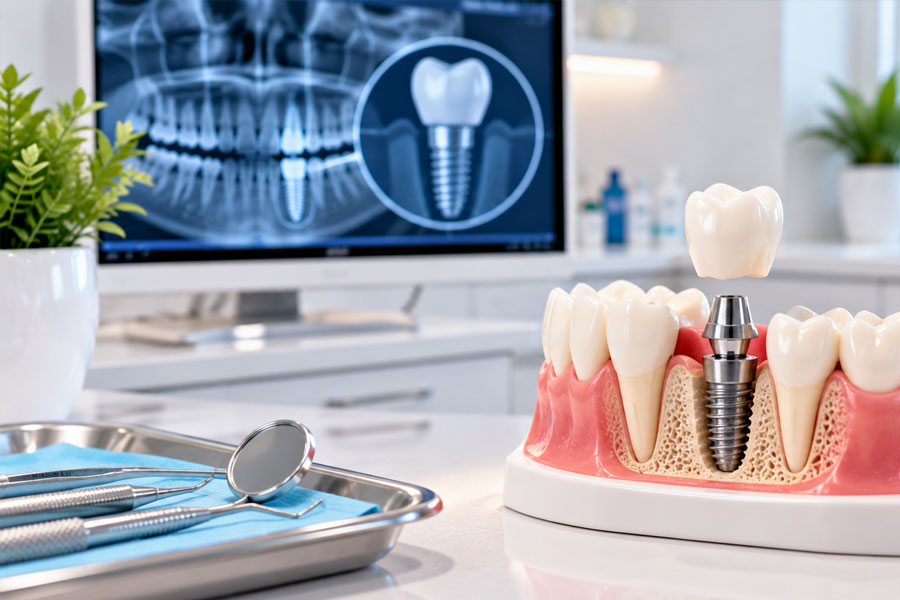
Losing a tooth can affect your smile, your ability to chew comfortably and the way surrounding teeth function. Dental implants provide a fixed option for replacing missing teeth by creating a stable foundation for a natural-looking dental restoration.
At Wise Dental, dental implant treatment is individually planned around your teeth, gums, jawbone and overall oral health.
Whether you’re missing a single tooth or require replacement of several teeth, we can assess your suitability for dental implants and explain the treatment options available.
A dental implant is a small artificial tooth root that is surgically positioned within the jawbone where a natural tooth has been lost.
Most dental implants are manufactured from titanium, a biocompatible material commonly used in implant dentistry.
Following placement, the surrounding jawbone gradually heals around and integrates with the implant through a process known as osseointegration.
Once sufficient healing and stability have been achieved, the implant can support a dental restoration such as a crown, providing a fixed replacement for the missing tooth.
A completed implant restoration generally consists of three main components.
The implant itself is positioned within the jawbone and performs a role similar to the root of a natural tooth.
An abutment is a connecting component positioned between the dental implant and the visible restoration.
The crown forms the visible replacement tooth above the gum line. It can be individually designed to complement the shape, size and colour of neighbouring teeth while restoring function to the area.
Together, these components create a fixed tooth replacement supported by the jawbone.
A missing tooth can create more than a visible gap within your smile.
Depending on its location, tooth loss may affect chewing and alter how biting forces are distributed throughout the mouth.
Neighbouring teeth can also gradually move towards an empty space, potentially changing their alignment and the way your bite comes together.
The jawbone in an area where a tooth has been lost can also gradually reduce because the natural tooth root is no longer providing stimulation to the surrounding bone.
Replacing a missing tooth may therefore help restore function as well as appearance.
For suitable patients, dental implants can offer several advantages.
Unlike a removable denture, a dental implant remains positioned within the jaw and provides a stable foundation for the replacement tooth.
The final dental crown can be designed to complement your surrounding teeth in shape, size and colour.
Replacing a missing tooth can restore function to the affected area and help distribute biting forces more effectively.
Dental implants transfer functional forces into the surrounding jawbone. This can help maintain bone around the implant site compared with leaving the area without a tooth root or implant.
A single dental implant can replace a missing tooth without requiring neighbouring teeth to support the restoration in the same way as a conventional dental bridge.
With appropriate care and maintenance, dental implants can provide a long-term solution for replacing missing teeth.
However, no implant should be considered guaranteed for life. Longevity varies according to oral hygiene, gum health, bite forces, smoking, general health and other individual factors.
Dental implants can be an option for many adults with missing teeth, but suitability needs to be assessed individually. Important considerations include:
Your dentist will review these factors before recommending implant treatment.
Having insufficient bone doesn’t necessarily mean dental implant treatment isn’t possible.
After a tooth is removed or lost, the surrounding jawbone can gradually decrease in height and width. If significant bone loss has occurred, there may not initially be enough structure to securely support an implant.
Depending on the location and extent of the bone loss, additional procedures may be considered.
Bone grafting can be used to rebuild areas where jawbone volume has been lost. Grafting material is placed within the treatment area to provide a framework that supports new bone development.
Once adequate healing has occurred, implant placement may be considered.
Learn moreWhen replacing teeth towards the back of the upper jaw, there may be limited bone between the mouth and the maxillary sinus.
A sinus lift can create additional space for bone development by carefully elevating the sinus membrane and placing grafting material beneath it.
Learn moreYour dental imaging will help determine whether either of these procedures is required.
Dental implant treatment generally takes place over several stages.
Your dentist begins by examining your teeth, gums and bite and discussing your dental and medical history.
Dental imaging may be used to assess the proposed implant site and determine how much bone is available.
The information gathered during your assessment is used to determine the appropriate implant position and overall treatment sequence.
If additional treatment such as tooth extraction, bone grafting or sinus augmentation is required, this can be incorporated into your plan.
Local anaesthetic is used to numb the treatment area. The implant is then carefully positioned within the jawbone at the planned location.
Following placement, the surgical area is allowed to begin healing.
Over the following months, the jawbone gradually integrates with the implant surface.
The length of this healing period varies depending on factors such as implant location, bone quality and whether grafting has been performed.
Once the implant has achieved sufficient stability, the restorative stage can proceed. An abutment connects the implant to the final dental crown.
The crown is individually designed with consideration for the surrounding teeth and your bite before being securely attached.
Dental implant treatment isn’t usually completed in a single appointment.
The total timeframe depends on your individual treatment plan and how quickly the implant integrates with the surrounding bone.
Treatment can take longer when tooth extraction, bone grafting or sinus lift surgery is required before the final restoration can be placed.
Rather than promising a fixed timeframe, your dentist can provide a more accurate estimate after assessing your jawbone and proposed implant site.
Local anaesthetic is used during implant placement to numb the surgical area.
After the procedure, some tenderness, swelling or discomfort can occur while the tissues begin to heal. The amount experienced varies between patients and according to the complexity of the procedure.
Your dentist will provide aftercare instructions and advice about managing discomfort following surgery.
Following implant placement, protecting the surgical site and maintaining good oral hygiene are important parts of recovery. You may be advised to:
Your dentist will monitor healing and advise when treatment can progress to the next stage.
Although the implant itself cannot develop tooth decay, the gums and bone surrounding it still require ongoing care.
Plaque accumulation around an implant can cause inflammation and potentially affect the tissues supporting it. Long-term care should include:
Your dental team can demonstrate appropriate cleaning techniques for your implant restoration.
Implants aren’t the only way to replace missing teeth. Your dentist can explain the advantages and considerations of each option before treatment.
Both implants and bridges can replace missing teeth, but they work differently. A conventional dental bridge generally uses neighbouring teeth to support the replacement tooth.
A dental implant creates its own support within the jawbone and doesn’t rely on adjacent teeth in the same way.
The best option depends on the condition of the surrounding teeth, available bone, location of the missing tooth and your individual preferences.
Crowns & bridgesDentures provide a removable solution for replacing multiple or completely missing teeth, whereas implants provide support from within the jawbone.
For some patients, implants can also be used to support larger dental restorations or improve the stability of certain tooth-replacement solutions.
The appropriate approach depends on how many teeth are missing, available bone, oral health and your treatment goals.
DenturesDental implant placement is a surgical procedure and, like all surgical treatments, carries potential risks. Possible complications can include:
The risks relevant to your particular implant site will be discussed before treatment.
The cost of dental implant treatment varies according to the number of teeth being replaced and the complexity of your individual treatment. Factors that can influence the overall cost include:
Following your assessment, Wise Dental can provide a personalised treatment plan outlining the recommended procedures and associated costs.
If you’re missing a tooth or considering alternatives to a removable tooth replacement, Wise Dental can assess whether dental implants may be suitable for you.
Our Sutherland Shire dental team can evaluate your teeth, gums and available jawbone, explain each stage of implant treatment and determine whether additional procedures such as bone grafting or a sinus lift may be required.
Your treatment plan will be developed around your individual oral health and tooth replacement needs.
Book a dental implant consultation with Wise Dental in Sutherland Shire to discuss your suitability and available tooth replacement options.
Book an Implant ConsultationAny surgical or invasive procedure carries risks. Before proceeding, you should seek a second opinion from an appropriately qualified health practitioner.