
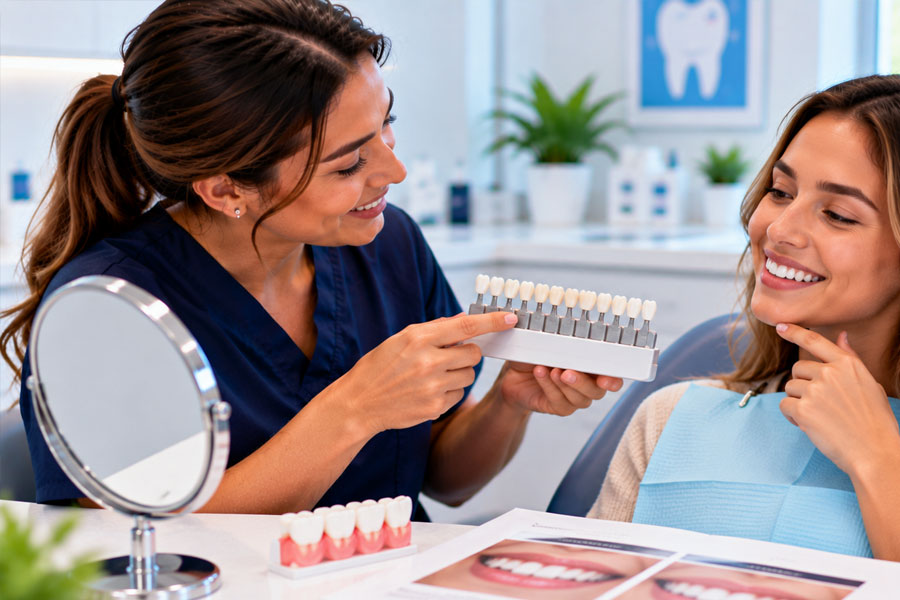
Dental veneers offer a cosmetic treatment option for changing the visible appearance of teeth that are chipped, cracked, discoloured or uneven.
A veneer is a thin, tooth-shaped layer of porcelain or composite material that is carefully applied to the front surface of a tooth. Each veneer is individually planned to complement the shape, size and colour of the surrounding teeth, helping create a balanced and natural-looking smile.
At Wise Dental, we offer both porcelain and composite veneers, with treatment tailored to your existing teeth and the changes you would like to achieve.
Dental veneers are thin restorations designed to cover the visible front surface of selected teeth.
Rather than replacing the entire tooth, as a dental crown does, a veneer primarily changes the appearance of the surface that is visible when you smile.
Depending on your individual circumstances, veneers may be considered for cosmetic concerns such as:
Before recommending veneers, your dentist will assess the health and condition of your teeth and discuss whether another cosmetic or restorative option may be more appropriate.
Wise Dental offers both porcelain veneers and composite veneers.
Each option has different characteristics, advantages and considerations. Your dentist can explain the differences and help you choose an appropriate material based on your teeth, cosmetic goals and treatment preferences.
Porcelain veneers are thin ceramic restorations individually manufactured to fit over the front surfaces of the teeth.
One of the main advantages of porcelain is its ability to closely reproduce the colour and translucency of natural tooth enamel. Each veneer can be designed to complement the surrounding teeth while improving the shape, colour or proportions of the treated tooth.
Porcelain also offers good resistance to staining compared with composite resin.
Because porcelain veneers are fabricated specifically for your teeth, treatment generally involves planning and preparation before the final restorations are fitted.
Composite veneers are created using tooth-coloured composite resin.
The material can be carefully shaped and bonded directly to the tooth to improve its visible appearance. Composite resin is also used extensively for tooth-coloured dental restorations.
Compared with porcelain veneers, composite treatment can generally be completed more simply and may provide a more affordable cosmetic option.
Another advantage is that composite can often be repaired if a small area becomes chipped or damaged.
Composite material can gradually stain and wear over time, so maintenance or replacement may eventually be required.
Composite veneers may last for up to approximately seven years, although their actual lifespan varies considerably depending on oral hygiene, bite forces, diet, grinding habits and how well they are maintained.
Both materials can improve the appearance of suitable teeth, but there are some important differences.
Porcelain veneers generally provide greater stain resistance and are individually manufactured from dental ceramic. They can provide excellent aesthetic results and are typically considered the longer-lasting option.
Composite veneers use tooth-coloured resin and can often be applied more conservatively and at a lower initial cost. The material is also easier to repair but generally isn’t as resistant to staining and wear as porcelain.
Neither option is automatically better for every patient.
Your dentist can consider the condition of your teeth, the number of teeth being treated, your bite and the cosmetic changes you’re looking for before recommending an appropriate approach.
The exact process depends on whether you’re having porcelain or composite veneers and how much preparation your teeth require.
Treatment begins with an assessment of your teeth, gums and bite. We’ll also discuss what you would like to change about your smile, such as tooth colour, shape, proportions or symmetry.
This is an important part of determining whether veneers are the right treatment or whether another option such as whitening, orthodontics or a dental crown would better address your concerns.
Depending on the type of veneer being placed, a small amount of enamel may need to be carefully removed from the front surface of the tooth.
This creates the space required for the veneer and allows the restoration to sit naturally within your smile rather than appearing unnecessarily bulky. The amount of preparation required varies between patients and the type of veneer being used.
At Wise Dental, we use dental imaging and planning technology to help design veneers according to your individual teeth. The shape, size and appearance of each veneer can be planned with consideration for your existing teeth and overall smile.
This stage helps establish how the proposed restorations will fit within your natural dental proportions before the final veneers are produced.
Once the design has been finalised, porcelain veneers are individually fabricated using the selected dental ceramic.
The aim is to produce restorations that fit accurately over the prepared teeth while complementing the surrounding natural teeth.
Once your final veneers are ready, your dentist checks their shape, fit, colour and overall appearance.
The teeth are appropriately prepared before the veneers are secured using dental bonding materials. Any necessary adjustments can then be made to ensure your bite feels comfortable.
For suitable patients, veneers can provide several cosmetic advantages. Depending on the teeth being treated, veneers may:
Porcelain veneers also provide good resistance to staining, while composite veneers offer the advantage of being relatively easy to repair if required.
It’s important to understand that veneers should be considered a long-term dental treatment rather than a temporary cosmetic procedure.
When natural enamel needs to be removed to accommodate a veneer, that change to the tooth cannot simply be reversed.
The veneer itself may eventually require maintenance or replacement because no dental restoration can be guaranteed to last indefinitely.
For this reason, your dentist should explain the benefits, limitations and alternative treatments before you decide to proceed.
Porcelain veneers are relatively resistant to staining compared with natural tooth enamel and composite resin.
Composite veneers can become discoloured over time, particularly with frequent exposure to substances such as coffee, tea, red wine and tobacco.
The natural teeth surrounding your veneers can also change colour over time, which may affect how closely they match the restorations.
Good oral hygiene and regular professional dental care can help maintain the appearance of both your veneers and natural teeth.
Veneers still require good everyday dental care.
Although the veneer itself cannot develop decay in the same way as natural enamel, the underlying and surrounding tooth structure remains susceptible to dental problems. To look after your veneers:
Your dentist can check the veneers, surrounding teeth and gums during routine appointments.
Veneers aren’t necessarily the most appropriate solution for every cosmetic concern.
Before treatment, your dentist will assess the health of your natural teeth, gums and bite. Existing problems such as tooth decay or gum disease may need to be treated first.
Depending on what you would like to change, alternative treatments may include professional teeth whitening, orthodontic treatment, composite bonding or dental crowns.
Your consultation allows you to compare these options before deciding whether veneers are appropriate.
Teeth whitening Orthodontics Crowns & bridges
If chipped, discoloured, uneven or irregularly shaped teeth are affecting the appearance of your smile, Wise Dental can assess whether porcelain or composite veneers may be suitable.
Our Sutherland Shire dental team can discuss the differences between the available veneer materials, explain the treatment process and develop a cosmetic treatment plan based on your individual teeth and smile.
Book a dental veneers consultation with Wise Dental in Sutherland Shire to explore porcelain and composite veneer options.
Book a Veneers Consultation