
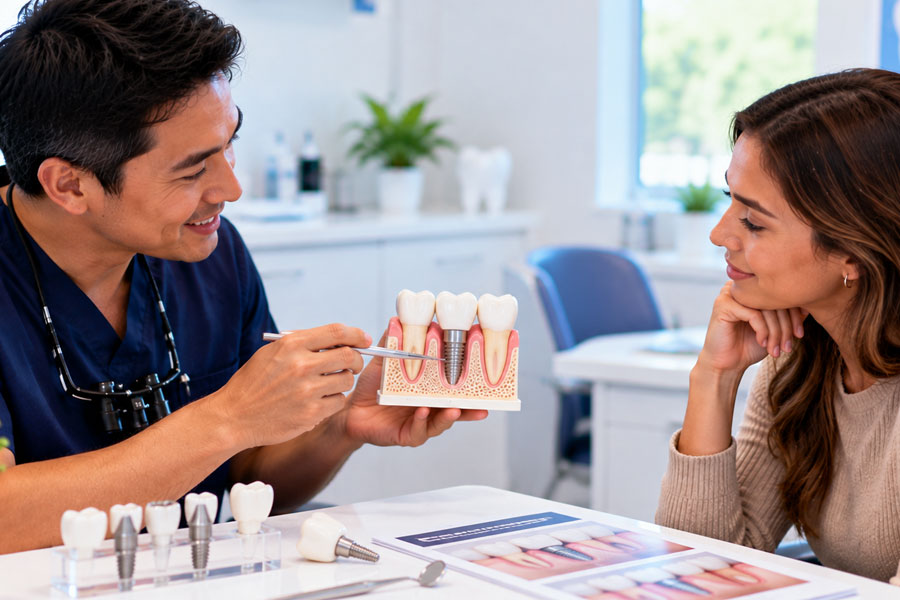
Dental implantology focuses on replacing missing or severely compromised teeth using implant-based restorations. Dental implants provide a fixed foundation for replacement teeth and can be used to restore a single missing tooth or form part of a more comprehensive tooth replacement plan.
At Wise Dental, implant treatment begins with a detailed assessment of your teeth, gums and jawbone. This allows us to determine whether implants are appropriate and whether supporting procedures such as bone grafting or a sinus lift may be required before implant placement.
Every treatment plan is developed around your individual oral health, available bone and restorative needs.
A dental implant is an artificial tooth root that is surgically positioned within the jawbone.
Most conventional implants are manufactured from titanium, a biocompatible material that can integrate with the surrounding bone through a process known as osseointegration.
Once the implant has integrated and the area has healed sufficiently, it can provide a stable foundation for a dental restoration such as a crown.
Unlike a removable replacement tooth, an implant is designed to remain fixed within the jaw.
Implant treatment sometimes involves more than simply placing the dental implant. Depending on your existing bone and the location of the missing tooth, your treatment plan may incorporate:
Dental implants can replace missing teeth by providing a fixed foundation for a dental crown or another implant-supported restoration.
The implant itself is positioned within the jawbone and allowed to integrate before the final restoration is attached.
Adequate bone is important for supporting a dental implant.
If bone volume has reduced following tooth loss, gum disease or another dental condition, bone grafting may be recommended to rebuild the area before implant placement.
The graft provides a framework that supports the development of additional bone within the treatment area.
Learn moreThe maxillary sinuses are positioned above the upper back teeth. In some patients, there may not be sufficient bone between the sinus and mouth to accommodate an implant.
A sinus lift creates additional space by carefully elevating the sinus membrane and placing bone graft material beneath it.
Once adequate healing and bone development have occurred, implant treatment may be able to proceed.
Learn moreDifferent implant designs can be considered depending on the patient’s jawbone, anatomy and treatment requirements.
Endosteal implants are the most commonly used type of dental implant.
They are surgically positioned directly within the jawbone and are generally manufactured from titanium.
Following placement, the implant is given time to integrate with the surrounding bone. Once sufficiently stable and healed, it can support the planned dental restoration.
Subperiosteal implants use a different approach and aren’t embedded directly into the jawbone in the same manner as endosteal implants.
Instead, the implant framework is positioned beneath the gum tissue and above the jawbone.
This type of implant has historically been considered for patients with insufficient bone to accommodate a conventional endosteal implant.
Modern implant dentistry provides several options for patients with reduced bone volume, so your dentist will assess which approach is appropriate for your individual circumstances.
Zygomatic implants are considerably longer than conventional dental implants and gain support from the zygomatic or cheekbone rather than relying solely on the upper jawbone.
They may be considered in complex cases where significant bone loss in the upper jaw makes conventional implant placement difficult.
Zygomatic implant treatment is more specialised than routine dental implant placement and requires careful assessment and treatment planning.
Implant treatment generally takes place over several stages rather than being completed in a single procedure.
Treatment begins with an examination of your teeth, gums, bite and jawbone. Appropriate dental imaging may be used to assess the amount and quality of available bone and the anatomical structures surrounding the proposed implant site. Your general and oral health will also be considered when determining whether implant treatment is suitable.
Once your assessment has been completed, an individual implant plan can be developed. This includes determining the appropriate implant position and identifying whether procedures such as bone grafting or sinus augmentation are required beforehand.
Local anaesthetic is used to numb the treatment area before the dental implant is carefully positioned within the jawbone. Once the implant has been placed, the gum tissue is managed appropriately and the area is allowed to begin healing.
During the healing period, the surrounding jawbone gradually integrates with the surface of the implant. This biological process helps create the stable foundation required to support the final dental restoration. Healing times vary between patients and depend on factors including bone quality, implant location and whether additional grafting procedures have been performed.
Once sufficient healing and implant stability have been achieved, the restorative stage can begin. A custom-made dental crown can be attached to the implant to replace the visible portion of the missing tooth. The crown is designed with consideration for the shape, size and appearance of the surrounding teeth as well as your bite.
Dental implants can provide several advantages for suitable patients.
Because an implant integrates with the jawbone, it provides a fixed foundation for the replacement tooth rather than relying on a removable appliance.
Natural tooth roots stimulate the surrounding jawbone. Following tooth loss, the bone in that area can gradually reduce in volume.
An implant transfers functional forces into the surrounding bone and may help maintain bone around the implant site.
The visible dental crown can be designed to complement the size, shape and colour of neighbouring teeth, creating a natural-looking replacement.
A stable implant-supported tooth can restore biting and chewing function in the area where a tooth has been lost.
Unlike removable dentures, the implant remains fixed in position during normal everyday use.
The titanium implant itself cannot develop tooth decay. However, the gums and surrounding tissues still require excellent oral hygiene, as inflammation and disease around an implant can affect its long-term health.
Not everyone is automatically suitable for implant treatment. Three particularly important considerations are:
Other factors can also influence treatment planning, including smoking, medical conditions, medications, oral hygiene and the location of the missing tooth.
Having reduced bone doesn’t necessarily rule out implant treatment. In some circumstances, bone grafting, sinus augmentation or another implant approach may be considered.
A detailed assessment is required before determining your suitability.
Dental implants cost approximately $3,000–$5,500 per tooth. The actual cost can vary depending on the complexity of treatment and whether additional procedures are required.
Factors affecting the total cost may include:
Following your assessment, a personalised treatment plan can provide a clearer indication of the procedures and costs involved.
As with any surgical treatment, dental implant placement carries potential risks and complications. Potential risks include:
Additional risks can vary depending on the implant location, surrounding anatomy and complexity of treatment.
Before proceeding, your dentist will discuss the risks relevant to your individual procedure as well as alternative treatment options.
Dental implants are designed as a long-term tooth replacement option, but it isn’t appropriate to guarantee that an implant will last for life.
Longevity can be influenced by oral hygiene, gum health, smoking, bite forces, general health and how well the implant and restoration are maintained.
Regular dental examinations allow the implant, crown and surrounding tissues to be monitored over time.
Daily brushing and appropriate cleaning around the implant are also important for maintaining healthy surrounding gums and bone.
If you’re missing one or more teeth and would like to explore fixed tooth replacement options, Wise Dental can assess whether dental implants may be suitable for you.
Our Sutherland Shire dental team can evaluate your teeth, gums and available jawbone and explain the different stages of implant treatment.
Where there isn’t sufficient bone for conventional implant placement, we can also discuss whether additional procedures such as bone grafting or sinus lift treatment may form part of your implant plan.
Book a dental implant consultation with Wise Dental in Sutherland Shire to discuss your suitability, treatment options and expected costs.
Book an Implant ConsultationAny surgical or invasive procedure carries risks. Before proceeding, you should seek a second opinion from an appropriately qualified health practitioner.