
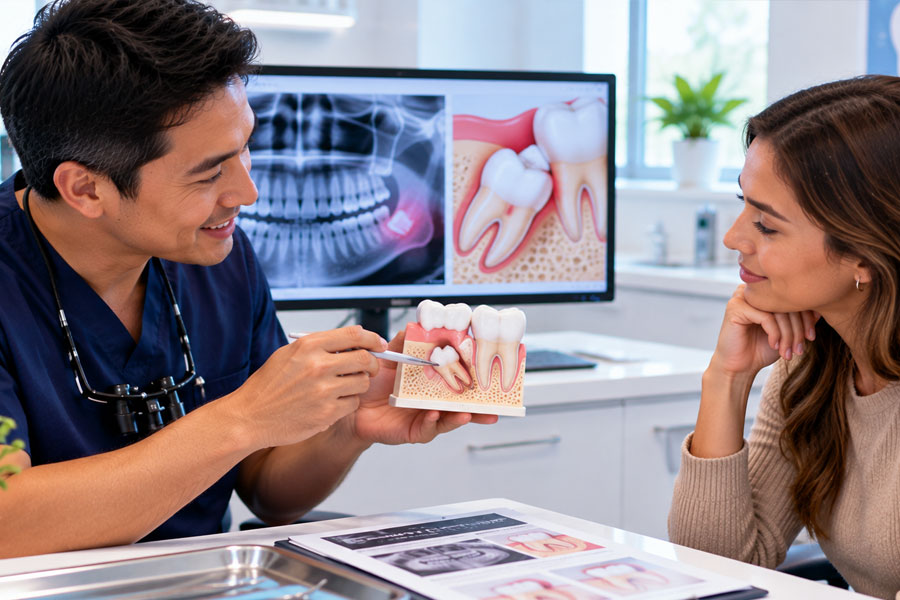
Wisdom teeth, also known as third molars, are the final adult teeth to emerge at the very back of the mouth. They commonly appear during the late teenage years or early adulthood.
For some people, wisdom teeth erupt normally and don’t cause any problems. For others, there may not be enough room in the jaw for these additional teeth to develop correctly. A wisdom tooth may become trapped beneath the gum, emerge at an angle or place pressure on neighbouring teeth.
When wisdom teeth cause pain, infection or other dental problems, removal may be recommended.
At Wise Dental, we can examine your wisdom teeth, assess their position and determine whether monitoring or extraction is the most appropriate option.
Not every wisdom tooth needs to be extracted. If the teeth are healthy, correctly positioned and aren’t affecting the surrounding teeth or gums, treatment may not be necessary.
Problems can occur when there isn’t enough space for a wisdom tooth to emerge normally.
A wisdom tooth may become impacted, meaning that it remains partially or completely trapped beneath the gum or surrounding bone. Other wisdom teeth may emerge at an angle or grow towards neighbouring teeth.
Problematic wisdom teeth can contribute to:
An examination and appropriate dental imaging can help determine the position of your wisdom teeth and whether removal should be considered.
Wisdom tooth problems don’t always begin with severe toothache.
You may need a dental assessment if you experience:
If pain or swelling becomes severe, particularly when accompanied by signs of infection, you should arrange a dental assessment as soon as possible.
An impacted wisdom tooth is unable to fully emerge into its normal position within the mouth.
This can happen because there isn’t enough room in the jaw or because the tooth is developing at an angle.
Some impacted wisdom teeth remain completely beneath the gum, while others partially erupt. A partially erupted tooth can create spaces around the gum where food debris and bacteria become trapped, making the area particularly difficult to keep clean.
Your dentist can use dental imaging to determine the position of an impacted tooth and assess its relationship with the surrounding teeth and structures.
The method used to remove a wisdom tooth depends on its position, whether it has erupted and the complexity of the extraction.
A straightforward erupted wisdom tooth may be removed using a conventional extraction technique, while an impacted tooth can require a surgical approach.
Wisdom tooth removal can take approximately 15 minutes to one hour, depending on the complexity of the procedure.
Your dentist will explain the expected procedure and anaesthetic options before treatment begins.
If the wisdom tooth has fully emerged through the gum and is relatively straightforward to access, removal may be performed under local anaesthetic.
The treatment area is thoroughly numbed before the procedure begins.
Specialised dental instruments are then used to carefully loosen the wisdom tooth before it is removed from its socket.
When several wisdom teeth require extraction, your dentist will determine whether they should be removed during the same appointment or across separate visits.
More complicated wisdom tooth surgery may require a different anaesthetic approach.
General anaesthetic may be considered when a wisdom tooth is trapped beneath the gum or when a more complex surgical extraction is required.
During a surgical extraction, access may need to be created through the gum to reach the impacted tooth. In some situations, the tooth may be divided into smaller sections so that it can be removed more carefully.
The area can also be checked for infection or other problems associated with the impacted tooth.
The appropriate anaesthetic option will depend on the complexity of the procedure and your individual circumstances.
Some swelling, tenderness and discomfort around the extraction area can occur following wisdom tooth surgery.
Your dentist will provide specific aftercare instructions based on the procedure you’ve undergone. During the initial recovery period, you may be advised to:
A blood clot forms within the extraction socket as part of the normal healing process, so it’s important to follow your dentist’s instructions to avoid unnecessarily disturbing the area.
The cost of wisdom tooth extraction varies according to the position of the tooth and the complexity of the procedure required.
Wisdom tooth removal is approximately $250–$500 per tooth.
Your actual treatment cost may vary depending on whether a simple or surgical extraction is required, the anaesthetic used and your individual treatment needs.
Medicare generally doesn’t cover private dental treatment, although eligible patients may have access to certain public dental services. Depending on your policy and level of cover, private health insurance may contribute towards the cost of treatment.
A personalised treatment plan and cost estimate can be provided following your examination.
No. The presence of wisdom teeth doesn’t automatically mean they need to be extracted.
Wisdom teeth that have erupted normally, remain healthy and aren’t causing problems may simply be monitored during routine dental examinations.
Removal is generally considered when the tooth is causing symptoms or there is a clinical reason why leaving it in place could create problems.
An assessment allows your dentist to recommend treatment based on the position and condition of your individual wisdom teeth rather than removing them unnecessarily.
If you’re experiencing pain, swelling or tenderness around the back of your mouth, your wisdom teeth may be contributing to the problem.
At Wise Dental, our Sutherland Shire dental team can examine your wisdom teeth, assess their position and discuss whether extraction is required.
From straightforward erupted wisdom teeth to more complex impacted teeth, your treatment will be planned according to your individual dental needs.
Book an appointment with Wise Dental in Sutherland Shire for a wisdom tooth assessment and personalised treatment advice.
Any surgical or invasive procedure carries risks. Before proceeding, you should seek a second opinion from an appropriately qualified health practitioner.