
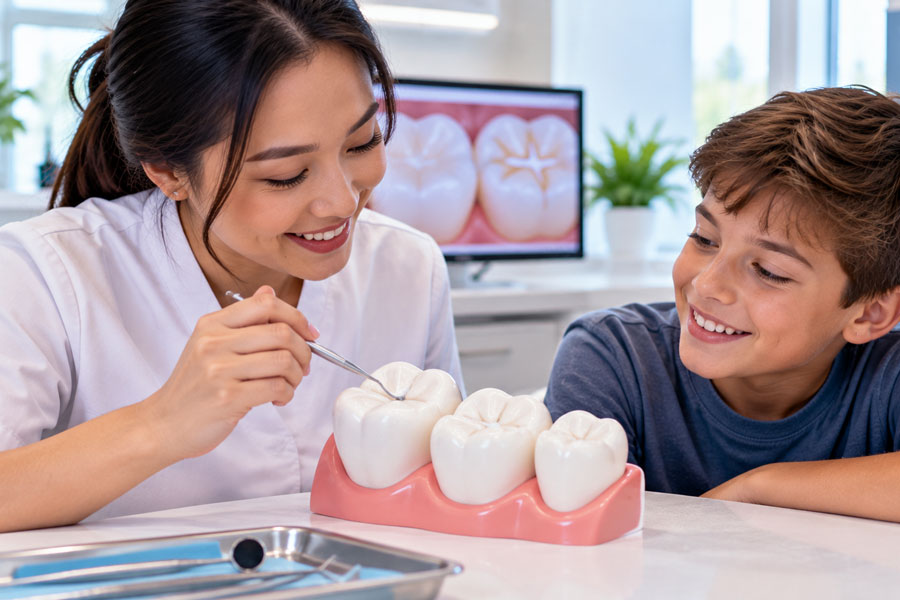
The chewing surfaces of your back teeth naturally contain small grooves and pits known as fissures. These areas can be particularly difficult to clean thoroughly with a toothbrush, allowing food particles and plaque to become trapped.
Over time, bacteria within these hard-to-reach grooves can contribute to tooth decay and cavities.
Fissure sealants provide an additional layer of protection by covering these vulnerable grooves with a protective dental material, creating a smoother surface that’s easier to keep clean.
A fissure sealant is a protective coating applied to the grooves and pits of a tooth, most commonly the chewing surfaces of the back molars.
Once applied, the sealant forms a barrier over the fissures, helping prevent plaque, bacteria and food particles from accumulating within them.
The smoother sealed surface can also make everyday brushing more effective, as there are fewer deep grooves where debris can become trapped.
During your regular dental examinations, your dentist can assess the condition of your molars and determine whether particular teeth could benefit from fissure sealants.
Fissure sealants can be suitable for both children and adults, depending on the condition and shape of the teeth.
Sealants are commonly recommended for children when their permanent molars have recently erupted.
Newly erupted teeth have had less exposure to decay, so protecting deep grooves at an early stage can help reduce the opportunity for plaque and food to become trapped in these areas.
Children can also find it difficult to thoroughly brush every surface of their back teeth, making additional protection particularly useful in some cases.
Adults may also benefit from fissure sealants, particularly when they have deep grooves in their molars that are difficult to keep clean or are concerned about developing cavities.
Your dentist will examine the tooth first to determine whether sealing the fissures is appropriate.
Applying a fissure sealant is generally a straightforward and non-invasive dental procedure.
Your dentist first checks the tooth and the condition of its grooves. If decay is present, this will need to be addressed before the tooth can be appropriately sealed.
Deep grooves are thoroughly cleaned so that food particles, plaque and other debris aren’t trapped beneath the sealant.
Only minimal preparation of the tooth surface is generally required. Anaesthetic is not usually necessary for a standard fissure sealant procedure.
A tooth-coloured material similar to white composite resin is carefully applied over the grooves and fissures. The material fills and covers these areas, producing a smoother surface while creating a protective barrier over parts of the tooth that may otherwise be difficult to clean.
Fissure sealants are designed to provide long-term protection, although they can gradually wear down as a result of normal biting and chewing.
Dental fissure sealants can last for approximately five to six years.
Their condition should still be checked during routine dental appointments. Your dentist can monitor the sealant for signs of wear and advise whether it needs repairing or replacing.
Fissure sealants can provide several preventive dental benefits for suitable teeth:
Covering deep grooves helps prevent bacteria and food debris from becoming trapped within them.
Sealing irregular grooves creates a smoother chewing surface that’s easier to reach with a toothbrush.
Newly erupted molars can be protected during a period when children may still be developing effective brushing habits.
Protecting areas prone to plaque accumulation may reduce the likelihood of decay developing there.
Applying a sealant generally requires minimal tooth preparation and doesn’t usually require anaesthetic.
Preventing decay from developing can reduce the likelihood of needing restorative treatment for cavities in the future.
No. Fissure sealants provide additional protection for vulnerable grooves, but they don’t replace good oral hygiene.
Brushing your teeth thoroughly, cleaning between your teeth, maintaining a tooth-friendly diet and attending regular dental examinations remain important for preventing tooth decay and maintaining healthy teeth and gums.
Your dentist will continue checking both the sealed and unsealed areas of your teeth during routine appointments.
Fissure sealants offer a simple way to provide additional protection to teeth with deep grooves that may be difficult to clean effectively.
At Wise Dental, we can examine your teeth or your child’s newly erupted molars and determine whether fissure sealants would be beneficial.
Regular dental check-ups also allow existing sealants to be monitored so they can be repaired or replaced if they begin to wear.
Book an appointment with Wise Dental in Sutherland Shire to find out whether fissure sealants could provide additional protection against tooth decay for you or your child.
Book an Appointment