
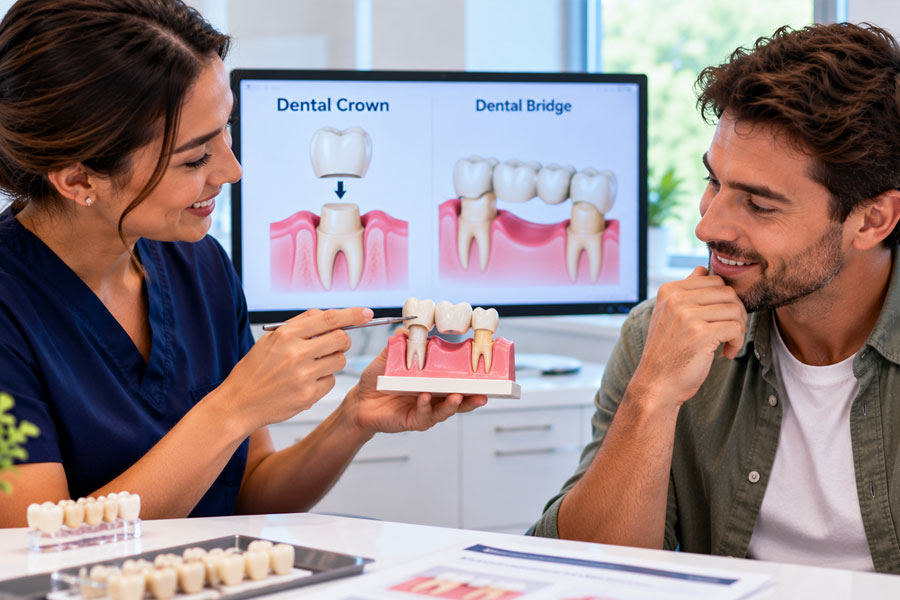
Damaged, weakened or missing teeth can affect more than the appearance of your smile. They can also make eating uncomfortable, alter the way your teeth come together and place additional pressure on surrounding teeth.
Dental crowns and bridges are fixed restorations used to rebuild damaged teeth or replace teeth that have been lost.
At Wise Dental, crowns and bridges are individually planned to complement your existing teeth while helping restore strength, function and the natural appearance of your smile.
A dental crown is a custom-made restoration that fits over a prepared natural tooth.
Sometimes referred to as a dental cap, a crown covers the visible portion of the tooth above the gum line. It can be used to restore a tooth that has become significantly weakened, damaged or compromised.
Crowns are designed to recreate the shape and size of the tooth while providing additional protection to the remaining tooth structure.
Your dentist may recommend a crown when a tooth requires more support than a conventional filling can provide.
A dental crown may be considered for:
Before recommending a crown, your dentist will examine the tooth and determine whether enough healthy structure remains to support the restoration.
Dental crowns can be manufactured from several different materials.
The most appropriate material will depend on factors such as where the tooth is located, the forces placed on it when biting, aesthetic requirements and your individual treatment needs.
Porcelain can provide a natural-looking restoration because its colour and translucency can be matched closely to surrounding teeth.
This makes porcelain particularly useful when appearance is an important consideration.
Modern dental ceramics can also provide a tooth-coloured restoration with a natural appearance.
Different ceramic materials have different strength and aesthetic characteristics, so your dentist can recommend an option based on the position of the tooth.
Porcelain-fused-to-metal crowns combine a metal substructure with an outer layer of tooth-coloured porcelain.
The internal metal provides strength while the porcelain improves the visible appearance of the restoration.
Metal crowns are extremely durable and can withstand significant biting forces.
Because of their metallic appearance, they are generally more suited to areas towards the back of the mouth where aesthetics may be less important.
Crown treatment generally involves preparing the affected tooth so the restoration can fit securely over it.
Any damaged or decayed tooth structure is addressed before the tooth is carefully reshaped to create sufficient room for the crown. Local anaesthetic can be used to keep the treatment area comfortable during preparation.
An impression or digital scan is taken to record the shape of the prepared tooth and its relationship with the surrounding teeth. This information is used to create a crown that fits your bite and complements your existing smile.
Depending on the type of crown and how it is manufactured, a temporary restoration may be placed over the prepared tooth while your final crown is being produced.
Once the final restoration is ready, your dentist checks its fit, shape, bite and appearance. After any necessary adjustments have been made, the crown is securely bonded or cemented into position.
A dental bridge is a fixed restoration designed to replace one or more missing teeth.
Unlike a removable denture, a conventional bridge remains secured in the mouth.
The replacement tooth — known as a pontic — occupies the space created by the missing tooth. It is supported by crowns or other retainers connected to neighbouring teeth.
This effectively creates a bridge across the gap, restoring the missing portion of your smile.
Leaving a gap after losing a tooth can sometimes lead to changes within the surrounding teeth and bite.
Neighbouring teeth may gradually move towards the empty space, potentially affecting their alignment. A missing tooth can also alter how biting and chewing forces are distributed throughout the mouth.
Replacing a missing tooth with an appropriate restoration may help:
Your dentist can discuss whether a bridge, dental implant or another tooth-replacement option is most suitable for you.
Different bridge designs can be used depending on the location of the missing tooth and the condition of the surrounding teeth.
A traditional bridge uses crowns placed on teeth on either side of the missing tooth.
The replacement tooth is attached between these crowns, creating a fixed restoration across the gap.
A cantilever bridge is supported from only one side of the missing tooth.
This type of restoration is only suitable in particular circumstances because the supporting tooth must carry the forces placed on the bridge.
A Maryland bridge uses a more conservative design in which the replacement tooth is supported by a framework or wings bonded to the back surfaces of neighbouring teeth.
Because the supporting teeth generally require less preparation than with a conventional bridge, this approach may be appropriate in selected situations.
When several teeth are missing, dental implants can sometimes be used to support a bridge rather than relying entirely on natural teeth.
Your dentist can assess the available bone, number of missing teeth and overall oral health to determine whether implant-supported treatment may be suitable.
Learn moreAlthough crowns and bridges are both fixed dental restorations, they serve different purposes.
A crown is primarily used to cover, strengthen and restore an existing tooth.
A bridge is designed to replace a tooth that is already missing by spanning the space between supporting teeth or implants.
Your dentist will recommend the appropriate restoration based on whether the tooth can be preserved or needs to be replaced.
The lifespan of a crown or bridge varies between patients.
Factors such as oral hygiene, bite forces, teeth grinding, diet and the condition of the supporting teeth can all affect how long a restoration remains in good condition.
Maintaining good oral hygiene and attending regular dental examinations allows your dentist to monitor the restoration and the health of the teeth and gums supporting it.
Although crowns and bridges themselves cannot develop decay in the same way as natural tooth enamel, the teeth supporting them can still experience dental problems.
Good oral hygiene is therefore essential. To care for your restoration:
Your dental team can demonstrate appropriate cleaning techniques for your particular restoration.
If you have a damaged, weakened or missing tooth, Wise Dental can assess the area and discuss the restorative options available.
Depending on the condition of your teeth, a dental crown may be used to strengthen and protect an existing tooth, while a dental bridge can provide a fixed solution for replacing one or more missing teeth.
Our Sutherland Shire dental team can explain the different materials and restoration options and develop a treatment plan based on your oral health, bite and individual needs.
Book a consultation with Wise Dental in Sutherland Shire to discuss dental crowns, bridges and suitable options for restoring damaged or missing teeth.
Book a Consultation